Saturday, January 30, 2021

TJMS Sleep-Deprivation

Sodium Valproate Improves Sensorimotor Gating Deficit Induced by Sleep-Deprivation in Low Doses

Muhammet Tekin, Fatma Duygu Kaya Yertutanol, Burcu Çevreli, Asil Ali Özdoğru, Hamza Kulaksız, and İsmail Tayfun Uzbay

Background/aim: Sleep-deprivation disrupts prepulse inhibition of acoustic startle reflex and can be used to mimic psychosis in experimental animals. On the other hand, it is also a model for other disorders of sensory processing including migraine. The aim of this study is to assess the effects of sodium valproate, a drug that is used in a variety of neuropsychiatric disorders, on normal and disrupted sensorimotor gating in rats. Materials and methods: 62 Wistar Albino rats were randomly distributed into 8 groups. Subchronic and intraperitoneal sodium valproate were administrated to the sleep-deprived and non-sleep-deprived rats by either in 50-100 or 200 mg/kg/day. Prepulse inhibition test and locomotor activity test were performed. Sleep-deprivation induced by the modified multiple platform method. Results: Sleep-deprivation impaired prepulse inhibition, decreased startle amplitude and increased locomotor activity. Sodium valproate did not significantly alter prepulse inhibition and locomotor activity in non-sleep-deprived and sleep-deprived groups. On the other hand, all doses decreased locomotor activity in drug treated groups, and low dose improved sensorimotor gating and startle amplitude after sleep-deprivation. Conclusion: Low dose sodium valproate improves sleep-deprivation-disrupted sensorimotor gating, and this finding may rationalize the use of sodium valproate in psychotic states and other disorders of sensory processing. Dose-dependent effects of sodium valproate on sensorimotor gating should be investigated in detail.

Keywords: Sleep deprivation; prepulse inhibition; psychosis; rat; sensorimotor gating; sodium valproate.

Citation: Tekin, M., Kaya Yertutanol, F. D., Çevreli, B., Özdoğru, A. A., Kulaksız, H., & Uzbay, İ. T. (2021). Sodium valproate improves sensorimotor gating deficit induced by sleep-deprivation in low doses. Turkish Journal of Medical Sciences51, 1521-1530. https://doi.org/10.3906/sag-2011-229

Saturday, January 16, 2021

Death Studies CORPD

Adaptation and Evaluation of COVID-19 Related Psychological Distress Scale Turkish Form

Tuğba Ay, Deniz Oruç, and Asil Ali Özdoğru

This study aimed to adapt COVID-19 Related Psychological Distress Scale (CORPD) into Turkish and evaluate its psychometric properties. Participants were assessed across the CORPD Turkish form, Symptom Checklist-90-Revised anxiety subscale, Fear of COVID-19 Scale, and the Brief Resilience Scale. Exploratory and confirmatory factor analyses confirmed a two-factor model in different subsamples, with satisfactory reliability. The total and subscale scores of the CORPD Turkish Form were positively correlated with anxiety and fear of COVID-19, and negatively correlated with resilience. The findings suggest that the CORPD Turkish form is a valid and reliable measure to assess the COVID-19 related psychological distress.

Citation: Ay, T., Oruç, D., & Özdoğru, A. A. (2021). Adaptation and evaluation of COVID-19 related Psychological Distress Scale Turkish form. Death Studies, 46(3), 560-568. https://doi.org/10.1080/07481187.2021.1873459

Thursday, January 07, 2021

SJPH C19 ISWS

The COVID-19 International Student Well-being Study

Sarah Van de Velde, Veerle Buffel, Piet Bracke, Guido Van Hal, Nikolett M. Somogyi, Barbara Willems, Edwin Wouters, and for the C19 ISWS Consortium

As a large international consortium of 26 countries and 110 higher-education institutions (HEIs), we successfully developed and executed an online student survey during or directly after the initial peak of the COVID-19 pandemic. The COVID-19 International Student Well-being Study (C19 ISWS) is a cross-sectional multicountry study that collected data on higher-education students during the COVID-19 outbreak in the spring of 2020. The dataset allows description of: (1) living conditions, financial conditions, and academic workload before and during the COVID-19 outbreak; (2) the current level of mental well-being and effects on healthy lifestyles; (3) perceived stressors; (4) resources (e.g., social support and economic capital); (5) knowledge related to COVID-19; and (6) attitudes toward COVID-19 measures implemented by the government and relevant HEI. The dataset additionally includes information about COVID-19 measures taken by the government and HEI that were in place during the period of data collection. The collected data provide a comprehensive and comparative dataset on student well-being. In this article, we present the rationale for this study, the development and content of the survey, the methodology of data collection and sampling, and the limitations of the study. In addition, we highlight the opportunities that the dataset provides for advancing social science research on student well-being during the COVID-19 pandemic in varying policy contexts. Thus far, this is, to our knowledge, the first cross-country student well-being survey during the COVID-19 pandemic, resulting in a unique dataset that enables high-priority socially relevant research.

Keywords: COVID-19, Corona, Higher education, Student well-being, multi-country study

Citation: Van de Velde, S., Buffel, V., Bracke, P., Van Hal, G., Somogyi, N. M., Willems, B., Wouters, E., & for the C19 ISWS Consortium (2021). The COVID-19 International Student Well-being Study. Scandinavian Journal of Public Health, 49, 114-122. https://doi.org/10.1177/1403494820981186

Monday, January 04, 2021

NHB Social Perception

To Which World Regions Does the Valence–Dominance Model of Social Perception Apply?

Benedict C. Jones, Lisa M. DeBruine, Jessica K. Flake, Marco Tullio Liuzza, Jan Antfolk, Nwadiogo C. Arinze, Izuchukwu L. G. Ndukaihe, Nicholas G. Bloxsom, Savannah C. Lewis, Francesco Foroni, Megan L. Willis, Carmelo P. Cubillas, Miguel A. Vadillo, Enrique Turiegano, Michael Gilead, Almog Simchon, S. Adil Saribay, Nicholas C. Owsley, Chaning Jang, Georgina Mburu, Dustin P. Calvillo, Anna Wlodarczyk, Yue Qi, Kris Ariyabuddhiphongs, Somboon Jarukasemthawee, Harry Manley, Panita Suavansri, Nattasuda Taephant, Ryan M. Stolier, Thomas R. Evans, Judson Bonick, Jan W. Lindemans, Logan F. Ashworth, Amanda C. Hahn, Coralie Chevallier, Aycan Kapucu, Aslan Karaaslan, Juan David Leongómez, Oscar R. Sánchez, Eugenio Valderrama, Milena Vásquez-Amézquita, Nandor Hajdu, Balazs Aczel, Peter Szecsi, Michael Andreychik, Erica D. Musser, Carlota Batres, Chuan-Peng Hu, Qing-Lan Liu, Nicole Legate, Leigh Ann Vaughn, Krystian Barzykowski, Karolina Golik, Irina Schmid, Stefan Stieger, Richard Artner, Chiel Mues, Wolf Vanpaemel, Zhongqing Jiang, Qi Wu, Gabriela M. Marcu, Ian D. Stephen, Jackson G. Lu, Michael C. Philipp, Jack D. Arnal, Eric Hehman, Sally Y. Xie, William J. Chopik, Martin Seehuus, Soufian Azouaghe, Abdelkarim Belhaj, Jamal Elouafa, John P. Wilson, Elliott Kruse, Marietta Papadatou-Pastou, Anabel De La Rosa-Gómez, Alan E. Barba-Sánchez, Isaac González-Santoyo, Tsuyueh Hsu, Chun-Chia Kung, Hsiao-Hsin Wang, Jonathan B. Freeman, Dong Won Oh, Vidar Schei, Therese E. Sverdrup, Carmel A. Levitan, Corey L. Cook, Priyanka Chandel, Pratibha Kujur, Arti Parganiha, Noorshama Parveen, Atanu Kumar Pati, Sraddha Pradhan, Margaret M. Singh, Babita Pande, Jozef Bavolar, Pavol Kačmár, Ilya Zakharov, Sara Álvarez-Solas, Ernest Baskin, Martin Thirkettle, Kathleen Schmidt, Cody D. Christopherson, Trinity Leonis, Jordan W. Suchow, Jonas K. Olofsson, Teodor Jernsäther, Ai-Suan Lee, Jennifer L. Beaudry, Taylor D. Gogan, Julian A. Oldmeadow, Benjamin Balas, Laura M. Stevens, Melissa F. Colloff, Heather D. Flowe, Sami Gülgöz, Mark J. Brandt, Karlijn Hoyer, Bastian Jaeger, Dongning Ren, Willem W. A. Sleegers, Joeri Wissink, Gwenaël Kaminski, Victoria A. Floerke, Heather L. Urry, Sau-Chin Chen, Gerit Pfuhl, Zahir Vally, Dana M. Basnight-Brown, Hans I. Jzerman, Elisa Sarda, Lison Neyroud, Touhami Badidi, Nicolas Van der Linden, Chrystalle B. Y. Tan, Vanja Kovic, Waldir Sampaio, Paulo Ferreira, Diana Santos, Debora I. Burin, Gwendolyn Gardiner, John Protzko, Christoph Schild, Karolina A. Ścigała, Ingo Zettler, Erin M. O’Mara Kunz, Daniel Storage, Fieke M. A. Wagemans, Blair Saunders, Miroslav Sirota, Guyan V. Sloane, Tiago J. S. Lima, Kim Uittenhove, Evie Vergauwe, Katarzyna Jaworska, Julia Stern, Karl Ask, Casper J. J. van Zyl, Anita Körner, Sophia C. Weissgerber, Jordane Boudesseul, Fernando Ruiz-Dodobara, Kay L. Ritchie, Nicholas M. Michalak, Khandis R. Blake, David White, Alasdair R. Gordon-Finlayson, Michele Anne, Steve M. J. Janssen, Kean Mun Lee, Tonje K. Nielsen, Christian K. Tamnes, Janis H. Zickfeld, Anna Dalla Rosa, Michelangelo Vianello, Ferenc Kocsor, Luca Kozma, Ádám Putz, Patrizio Tressoldi, Natalia Irrazabal, Armand Chatard, Samuel Lins, Isabel R. Pinto, Johannes Lutz, Matus Adamkovic, Peter Babincak, Gabriel Baník, Ivan Ropovik, Vinet Coetzee, Barnaby J. W. Dixson, Gianni Ribeiro, Kim Peters, Niklas K. Steffens, Kok Wei Tan, Christopher A. Thorstenson, Ana Maria Fernandez, Rafael M. C. S. Hsu, Jaroslava V. Valentova, Marco A. C. Varella, Nadia S. Corral-Frías, Martha Frías-Armenta, Javad Hatami, Arash Monajem, MohammadHasan Sharifian, Brooke Frohlich, Hause Lin, Michael Inzlicht, Ravin Alaei, Nicholas O. Rule, Claus Lamm, Ekaterina Pronizius, Martin Voracek, Jerome Olsen, Erik Mac Giolla, Aysegul Akgoz, Asil A. Özdoğru, Matthew T. Crawford, Brooke Bennett-Day, Monica A. Koehn, Ceylan Okan, Tripat Gill, Jeremy K. Miller, Yarrow Dunham, Xin Yang, Sinan Alper, Martha Lucia Borras-Guevara, Sun Jun Cai, Dong Tiantian, Alexander F. Danvers, David R. Feinberg, Marie M. Armstrong, Eva Gilboa-Schechtman, Randy J. McCarthy, Jose Antonio Muñoz-Reyes, Pablo Polo, Victor K. M. Shiramazu, Wen-Jing Yan, Lilian Carvalho, Patrick S. Forscher, Christopher R. Chartier, and Nicholas A. Coles

Over the past 10 years, Oosterhof and Todorov’s valence–dominance model has emerged as the most prominent account of how people evaluate faces on social dimensions. In this model, two dimensions (valence and dominance) underpin social judgements of faces. Because this model has primarily been developed and tested in Western regions, it is unclear whether these findings apply to other regions. We addressed this question by replicating Oosterhof and Todorov’s methodology across 11 world regions, 41 countries and 11,570 participants. When we used Oosterhof and Todorov’s original analysis strategy, the valence–dominance model generalized across regions. When we used an alternative methodology to allow for correlated dimensions, we observed much less generalization. Collectively, these results suggest that, while the valence–dominance model generalizes very well across regions when dimensions are forced to be orthogonal, regional differences are revealed when we use different extraction methods and correlate and rotate the dimension reduction solution.

Citation
: Jones, B. C., DeBruine, L. M., Flake, J. K., Liuzza, M. T., Antfolk, J., Arinze, N. C., Ndukaihe, I. L. G., Bloxsom, N. G., Lewis, S. C., Foroni, F., Willis, M. L., Cubillas, C. P., Vadillo, M. A., Turiegano, E., Gilead, M., Simchon, A., Saribay, S. A., Owsley, N. C., Jang, C., . . . Coles, N. A. (2021). To which world regions does the valence–dominance model of social perception apply? Nature Human Behavior, 5, 159–169. https://doi.org/10.1038/s41562-020-01007-2

Friday, January 01, 2021

FYI 2021

Do not merely practice your art, but force your way into its secrets; it deserves that, for only art and science can exalt man to divinity.

Ludwig van Beethoven (1812) Letter to Emilie


Truth is powerful, and, if not instantly, at least by slow degrees, may make good her possession. Gleams of good sense may penetrate through the thickest clouds of error. … and, as the true object of education is not to render the pupil the mere copy of his preceptor, it is rather to be rejoiced in, than lamented, that various reading should lead him into new trains of thinking; open to him new mines of science and new incentives to virtue; and perhaps, by a blended and compound effect, produce in him an improvement which was out of the limits of his lessons, and raise him to heights the preceptor never knew.

William Godwin (1797) The Enquirer


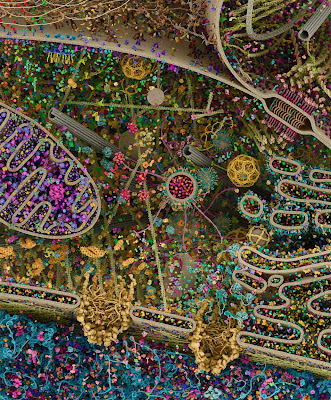
Cellular landscape cross-section through a eukaryotic cell
© 2021 Ingersoll & McGill


Thursday, December 31, 2020

GAD MMORPG

Devasa Çok Oyunculu Çevrimiçi Rol Yapma Oyunlarının Takım Çalışma ve Problem Çözme Becerilerine Etkisi

Asil Ali Özdoğru, Mehmet Yunus Gökalp ve Hümeyra Kuşçu

Amaç: Çevrimiçi bilgisayar oyunlarından bir tür olan Devasa Çok Oyunculu Çevrimiçi Rol Yapma Oyunları [Massively Multiplayer Online Role-Playing Game (MMORPG)] birçok kişinin internet yoluyla iletişim kurarak oynamalarına imkân sağlayan bir oyun türüdür. Bu araştırmanın amacı MMORPG’nin oyuncuların takım çalışma ve sosyal problem çözme becerilerine etkisinin incelenmesidir. Yöntem: Araştırma modeli olarak statik grup karşılaştırması tasarımı kullanılmış olup oyunu bir süredir oynayan deney grubu ve oynamayan kontrol grubunun son testleri karşılaştırılmıştır. Araştırmanın örneklemini 100’ü MMORPG, 18’i diğer video oyunları oynayan ve 42’si ise video oyunu oynamayan toplam 160 kişi oluşturmaktadır. Katılımcılara sosyodemografik bilgi formu, Ergenler İçin Takım Çalışması Ölçeği, Sosyal Problem Çözme Envanteri Kısa Formu ve Oyun Motivasyonu Ölçeği uygulanmıştır. Temel Sonuçlar: Yapılan analizlerde oyuncu grupların ve oyuncu olmayan grupların takım çalışması ve sosyal problem çözme ortalama puanlarının istatiksel olarak anlamlı bir farklılık göstermediği görülmüştür. Yalnızca MMORPG oyuncularının diğer iki gruba kıyasla sosyal problem çözmede daha fazla kaçınan tarzda davranışlar sergilediği bulunmuştur. Genel olarak çevrimiçi bilgisayar oyuncularının takım çalışma ve sosyal problem çözme becerilerinin oyun oynama motivasyonlarıyla yakından ilgili olduğu da gözlenmiştir. Araştırma ve Uygulama için Öneriler: Özellikle genç yaştaki bireylerin giderek daha çok oranda yer aldığı bu çevrimiçi oyunların davranışsal ve gelişimsel etkilerinin temsil gücü daha yüksek, geniş katılımlı, boylamsal ve nitel çalışmalarla incelenmesine ihtiyaç vardır.

Anahtar Kelimeler: Devasa Çok Oyunculu Çevrimiçi Rol Yapma Oyunları, Takım Çalışması, Sosyal Problem Çözme

Atıf: Özdoğru, A. A., Gökalp, M. Y. ve Kuşcu, H. (2020). Devasa Çok Oyunculu Çevrimiçi Rol Yapma Oyunlarının takım çalışma ve problem çözme becerilerine etkisi. Gençlik Araştırmaları Dergisi, 8(22), 114-135. https://dergipark.org.tr/tr/download/article-file/1262443


The Effect of Massively Multiplayer Online Role-Playing Games on Teamwork and Problem-Solving Skills

Asil Ali Özdoğru, Mehmet Yunus Gökalp, and Hümeyra Kuşçu

Purpose: Massively Multiplayer Online Role-Playing Game (MMORPG), which is a type of online computer games, is a game genre that allows many people to communicate and play online. The aim of this study is to investigate the impact of MMORPG on players’ teamwork and social problem-solving skills. Method: In this research, static group comparison design was used. The posttest scores of the experimental group who play the MMORPG games and the control group who do not play video games were compared. The sample of the study consisted of 160 participants, 100 of whom were MMORPG players, 18 of whom played other video games and 42 of whom did not play video games. The sociodemographic information form, the Teamwork Scale for Youth, Social Problem Solving Inventory-Short Form and the Gaming Motivation Scale were administered to the participants. Key Results: In the analysis, it was seen that the player groups and the nonplayer group did not have a statistically significant difference in the mean scores of teamwork and social problem-solving. In comparison to other two groups, MMORPG players showed an avoidance in social problem-solving. Suggestions for Research and Application: There is a need to examine the behavioral and developmental effects of these online games, which especially involve younger individuals, with more representative, broad, longitudinal and qualitative studies.

Keywords: Massively Multiplayer Online Role-Playing Games, Teamwork, Social Problem-Solving

Citation: Özdoğru, A. A., Gökalp, M. Y., & Kuşcu, H. (2020). The Effect of Massively Multiplayer Online Role-Playing Games on teamwork and problem-solving skills [Extended abstract]. Journal of Youth Research, 8(22), 114-135. https://dergipark.org.tr/tr/download/article-file/1262443

Sunday, December 20, 2020

UPK 2020

COVID-19 Salgınında Üniversite Öğrencilerinin İyilik Hali: Türkiye’den Dokuz Üniversite Örneği

Asil Ali Özdoğru, Hatice Gülsen Erden, Sami Çoksan, Hale Ögel-Balaban, Aysun Ergül-Topçu, Yeşim Yasak, İlkiz Altınoğlu Dikmeer, Yakup Azak, Gözde Kıral Uçar ve Gülsen Baytemir

AMAÇ: 2019 yılının Aralık ayında Çin’in Vuhan Eyaleti’nde ortaya çıkan Yeni Koronavirüs Hastalığı (COVID-19) kısa sürede küresel bir salgına dönüşerek insanların beden ve ruh sağlığı üzerinde önemli etkilere sebep olmuştur. Hem geçmiş salgınlarla ilgili hem de kısa sürede COVID-19 ile ilgili yapılan araştırmalar, bu salgının genel nüfus üzerindeki psikolojik etkilerini ortaya koymuştur. Ancak yükseköğretim öğrenci nüfusu hakkında yeterince araştırma bulunmamaktadır. Uluslararası bir projenin parçası olan bu çalışmada, COVID-19 salgınının Türkiye’de üniversite öğrenimi gören öğrencilerin iyilik haline olan etkisi incelenmiştir. YÖNTEM: Anlık tekil tarama modelinin kullanıldığı bu çalışmada katılımcılara 2020 Mayıs ayında çevrimiçi bir anket uygulanmıştır. Çalışmaya üç vakıf altı devlet üniversitesinden %69’u kadın, yaş ortalaması 23,6 (SS=6,20) olan toplam 9.593 öğrenci katılmıştır. Çalışmada katılımcılara sosyodemografik sorulara ek olarak, COVID-19 tanısı alıp almadıkları, salgın öncesi ve sonrası durumları, stres etkenleri ve iyilik halleriyle ilgili sorular sorulmuştur. BULGULAR Öğrencilerin %95’inin hastalığı geçirmediği, salgın öncesine kıyasla salgın döneminde daha fazla oranda anne-babalarıyla ikamet ettikleri (%82), mali kaynaklarının azaldığı (%28), sigara kullanımlarının (%9) ve fiziksel aktivitelerinin (%32) azaldığı ve aileleriyle sosyal temasları artarken (%46) arkadaşlarıyla temaslarının azaldığı (%69) bulunmuştur. Öğrencilerin serbest zamanlarında salgın öncesine göre daha fazla elektronik oyun oynadıkları (ort.=3,39/5), daha fazla sosyal medya kullandıkları (ort.=3,94/5) ve daha fazla dizi veya film izledikleri görülmüştür (ort.=4,00/5). Buna ek olarak öğrenciler salgın döneminde can sıkıntısı (ort.=2,94/4) ve kaygı (ort.=2,69/4) hissettiklerini, kendilerinin hasta olmasına kıyasla yakın çevrelerinden bir kişinin hasta olmasından daha çok endişe ettiklerini (ort.=7,38/10) bildirmişlerdir. Öğretim elemanlarıyla hem dersler hakkında (%35) hem de psikososyal sorunlarıyla ilgili (%29) daha az iletişim kuran öğrenciler sadece %7 oranında psikolojik danışmanlık birimleriyle iletişime geçmişlerdir. Öğrenciler üniversitelerinde yapılan değişiklikler hakkında yeterince bilgilendirilmediklerini (ort.=2,61/5) ve salgının eğitim kalitesini olumsuz yönde etkilediğini (ort.=2,58/5) ifade etmişlerdir. SONUÇ: Bu bulgular devam eden salgın döneminde yükseköğretim paydaşları tarafından dikkate alınarak geliştirilecek politika ve uygulamalarda karar vermede yardımcı olarak değerlendirilebilir.

Atıf: Özdoğru, A. A., Erden, H. G., Çoksan, S., Ögel-Balaban, H., Ergül-Topçu, A., Yasak, Y., Altınoğlu Dikmeer, İ., Azak, Y., Kıral Uçar, G. ve Baytemir, G. (2020). COVID-19 salgınında üniversite öğrencilerinin iyilik hali: Türkiye’den dokuz üniversite örneği [Bildiri özeti]. Türk Psikiyatri Dergisi, 31(Ek 1), 48.

Basından: COVID-19 Salgınının Öğrenciler Üzerindeki Etkisi Araştırıldı (23 Aralık 2020) https://uskudar.edu.tr/tr/icerik/6063/covid-19-salgininin-ogrenciler-uzerindeki-etkisi-arastirildi

Friday, October 30, 2020

TURKCESS 2020 A

Çocukların Bellek Gelişiminde Sözelleştirme Stratejisi: Kayıtlı Bir Replikasyon Çalışması

Asil Ali Özdoğru, Büşra Bayram ve Sırrı Akbaba

Çocukların bellek gelişiminde sözelleştirme stratejisi önemli bir yer tutmaktadır. Sözelleştirme, çalışma belleğindeki bilginin sesli tekrarıdır ve bu stratejinin kullanımı yaş gruplarında farklılık göstermektedir. Flavell ve arkadaşları (1966) çalışmalarında, sözelleştirme davranışının yedi ve on yaşındaki çocuklarda beş yaşındaki çocuklara göre daha çok görüldüğünü ve bellek performanslarının arttığını bulmuşlardır. Bu çalışma, alanyazında çok önemli bir yer tutuğu ve çokça atıf yapıldığı halde tekrarı sadece bir kez yapılmış bir araştırmadır. Mevcut çalışmada ise bu araştırma bulgularının Türk çocuklarındaki geçerliği orijinal çalışmanın yöntem ve gereçlerine büyük ölçüde sadık kalınarak uluslararası kayıtlı bir replikasyon araştırmasıyla incelenmiştir. Çalışmaya İstanbul’dan beş, altı, yedi ve on yaş gruplarından dörder kız ve erkek toplam 32 öğrenci katılmıştır. Katılımcılar bireysel olarak okul ortamında araştırmacıların gözetiminde bilgisayar programındaki hafıza oyununu oynarken davranış ve performansları gözlemlenmiştir. Oyunda katılımcılara bazı nesne resimleri gösterilmiş ve farklı bellek görevleri verilmiştir. Araştırmacılar katılımcıların dudak hareketleri, sözelleştirme davranışları ve strateji beyanlarını kayıt ederek kodlamışlardır. Bu çalışmada elde edilen verilerin analiz sonuçları da on yaşındaki çocukların beş yaşındakilere kıyasla istatistiksel olarak anlamlı seviyede daha fazla sözelleştirme davranışında bulunduklarını göstermektedir. Ayrıca altı görevden ikisinde yaşla birlikte anlamlı olarak artan sözelleştirme kullanımı ve genelde yaşla birlikte artan bir bellek performansı bulunmuştur. Mevcut çalışmanın bulguları Flavell’ın sonuçlarının Türk çocuklarda da geçerli olduğunu ve yaş arttıkça sözelleştirme davranışının ve bellek performansının arttığını ortaya koymaktadır. 

Atıf: Özdoğru, A. A., Bayram, B. ve Akbaba, S. (2020, Ekim 30-Kasım 1). Çocukların bellek gelişiminde sözelleştirme stratejisi: Kayıtlı bir replikasyon çalışması [Sözlü bildiri sunumu]. VI. Uluslararası TURKCESS Eğitim ve Sosyal Bilimler Kongresi, İstanbul, Türkiye. http://2020.turkcess.net/tr/anasayfa/


Verbalization Strategy in Children's Memory Development: A Registered Replication Study

Verbalization strategy plays an important role in children's memory development. Verbalization is the vocal repetition of information in the working memory, and the use of this strategy differs across age groups. In their study, Flavell et al. (1966) found that verbalization behavior was more common and the memory performance was higher in seven- and ten-year-olds in comparison to five-year-olds. Although this study is important in the literature and has received many citations, it has been replicated only once. In the present study, as part of an international registered replication study, validity of these research findings in Turkish children was examined by following the methods and materials of the original study. A total of 32 students from İstanbul, four girls and four boys from five, six, seven, and ten year old age groups, participated in the study. Participants’ behaviors and performances were observed while they were individually playing a memory game at a computer program in their schools. In the game, participants were shown images of several objects and given different memory tasks. The researchers observed and coded the lip movements, verbalization behaviors, and strategy statements of the participants. Analysis of the data obtained in this study indicated that ten-year-old children exhibited statistically significantly higher rate of verbalization behaviors than five-year-olds. Additionally, when the differences between tasks were examined, in two of the six tasks, the use of verbalization significantly increased with age. Findings of the present study reveal that Flavell's results are also valid in Turkish children and that verbalization behavior and memory performance increase as age increases.

Citation: Özdoğru, A. A., Bayram, B., & Akbaba, S. (2020, October 30-November 1). Verbalization strategy in children's memory development: A registered replication study [Oral paper presentation]. VI. International TURKCESS Education and Social Sciences Congress, İstanbul, Turkey. http://2020.turkcess.net/en/homepage/

TURKCESS 2020 B

Çocuk Odaklı Sosyal Uyum: Bir Kavramsal Model Önerisi

Asil Ali Özdoğru, Sırrı Akbaba ve Ebulfez Süleymanlı

Sosyal uyum bir bireyin veya grubun kendi özgür iradesiyle diğer gruplarla ortak sosyal hayatı yaşamak için ortak amaçlarla hareket etmesi olarak tanımlanmaktadır. Sosyal uyum kavramının alanyazında ve sahada çeşitli tanım ve uygulamaları mevcuttur. Bu çalışmada önceki tanımlamalar ışığında çocuklara yönelik yeni bir sosyal uyum modeli ortaya konmaktadır. İngilizce alanyazında “social cohesion” olarak ele alınan sosyal uyum kavramının tanımlamaları ve ölçümleri 3 temel özellik ve 9 boyutta özetlenmiştir (Schiefer vd., 2012). Sosyal ilişkiler temel özelliği, sosyal ağ kurma, katılım, güven ve çeşitliliğin kabulü boyutlarını içerirken; bağlılık temel özelliği, ait olma hissi ve özdeşleşmeyi; genel iyiliğe yönelim temel özelliği ise sosyal sorumluluk, dayanışma, sosyal düzenin tanınması boyutlarını içermektedir. Türkiye’de yapılan bir çalışmada benzer bir model kullanılarak sosyal uyum 3 ana bileşen ve 9 alt bileşenle ölçülmüştür (Ataseven ve Bakış, 2018). Bağlantılılık ana bileşeni, aidiyet, kurumlara güven, adalet algısı alt bileşenlerinden; sosyal ilişkiler ana bileşeni, sağlam sosyal ağlar, insanlara güven, çoğulculuğun tanınması alt bileşenlerinden; ortak fayda anlayışı ana bileşeni, dayanışma ve yardımseverlik, sosyal kurallara uyum, sivil katılım alt bileşenlerinden oluşmaktadır. UNICEF (2019) tarafından Ürdün’de yapılan bir çalışmada ise sosyal uyumun tanımlanmasında çocukların görüş ve bakış açılarının 3 kavram ve 9 temayı içerdiği görülmüştür. Buna göre, ait ve dâhil olma kavramı çerçevesinde çocuklar kendilerini danışılmış, dinlenilmiş ve anlaşılmış hissederler, yetişkinlerle iyi ilişkileri vardır, eşit muamele görürler, arkadaşları vardır, güven hem dikey hem de yatay olarak bulunmaktadır ve açık yardım yapılarına sahiptirler. Katılım kavramı çerçevesinde ifade ve katılım özgürlüğü vardır ve herkes faaliyetlere dâhildir. Hoşgörü kavramı çerçevesindeyse şiddet ve zorbalık hem dikey hem de yatay olarak yoktur. Bu çalışmalardan hareketle sosyal uyum süreçlerinde çocuklara daha çok yer veren yeni bir kavram önerisi geliştirilmiştir. Çocuk odaklı sosyal uyum olarak adlandırdığımız bu kavramının 3 bileşen ve 9 tema üzerinden betimlenebileceği değerlendirilmektedir. Önerilen bu modele göre ilişkiler bileşeni, sosyal ağ, katılım ve çeşitlilik temalarından oluşmaktadır. Bağlılık bileşeni, ait olma, dâhil olma ve özdeşim temalarından oluşmaktadır. Düzen bileşeni ise sorumluluk, dayanışma ve hoşgörü temalarından oluşmaktadır. Bu kavramsal modelin yapılacak temel ve uygulamalı çalışmalarla sahada denenmesi ve gözden geçirilmesi hedeflenmektedir.  

Atıf: Özdoğru, A. A., Akbaba, S. ve Süleymanlı, E. (2020, Ekim 30-Kasım 1). Çocuk odaklı sosyal uyum: Bir kavramsal model önerisi [Sözlü bildiri sunumu]. VI. Uluslararası TURKCESS Eğitim ve Sosyal Bilimler Kongresi, İstanbul, Türkiye. http://2020.turkcess.net/tr/anasayfa/


Child-Focused Social Cohesion: A Proposal for a Conceptual Model

Social cohesion is defined as the action of an individual or group of their own free will with common goals to live a common social life with other groups. The concept of social cohesion has various definitions and applications in the literature and in the field. In this study, a new social cohesion model for children is presented in the light of previous definitions. The definitions and measurements of the concept of social cohesion, which is considered as "social cohesion" in the English literature, are summarized in 3 core aspects and 9 dimensions (Schiefer et al., 2012). While the core aspect of social relations includes the dimensions of social networking, participation, trust, and acceptance of diversity; the core aspect of connectedness includes dimensions of feeling of belonging and identification. The core aspect of orientation towards the common good includes the dimensions of social responsibility, solidarity, and recognition of the social order and social rules. Using a similar in a study in Turkey, social cohesion model was measured in 3 main components and 9 sub-components (Ataseven & Bakış, 2018). First main component of connectedness includes sub-components of belonging, trust in institutions, and perception of justice. Second main component of social relations includes solid social networks, trust in people, recognition of pluralism. Third sub-component of understanding of common benefit includes sub-components of solidarity and benevolence, compliance with social rules, and civic participation. In a study conducted by UNICEF (2019) in Jordan, it was seen that children's views and perspectives of social cohesion included 3 concepts and 9 themes. Accordingly, within the concept of belonging and inclusion, children feel themselves consulted, listened to and understood, have good relationships with adults, are treated equally, have friends, trust exist both vertically and horizontally, and have clear support structures. Within the concept of participation, there is freedom of expression and participation and everyone is involved in the activities. Under the concept of tolerance, violence and bullying do not exist both vertically and horizontally. Based on these studies, a new conceptual model has been proposed to include more room for children in the social cohesion processes. It is considered that this concept, which we call child-focused social cohesion, can be described in 3 components and 9 themes. According to this proposed model, the relationships component consists of themes of social networking, participation and diversity. Connectedness component consists of the themes of belonging, inclusion and identification. The component of order consists of themes of responsibility, solidarity and tolerance. We are aiming to test and review this conceptual model in the field with basic and applied studies. 

Citation: Özdoğru, A. A., Akbaba, S., & Süleymanlı, E. (2020, October 30-November 1). Child-focused social cohesion: A proposal for a conceptual model [Oral paper presentation]. VI. International TURKCESS Education and Social Sciences Congress, İstanbul, Turkey. http://2020.turkcess.net/en/homepage/

Wednesday, January 01, 2020

FYI 2020

Wisdom, therefore, is what seizes upon happiness in truth, whereas prudence is what seizes upon what ought to be done so that happiness is attained. These two, therefore, are the two mutual assistants in perfecting the human being—wisdom being what gives the ultimate goal, and prudence being what gives the means by which that goal is gained.

al-Farabi (870-950) The Political Writings: "Selected Aphorisms" and Other Texts


Poets are all who love, who feel great truths,
And tell them; and the truth of truths is love.

Philip J. Bailey (1839) Festus


First direct image of a black hole at the centre of the galaxy M87 © 2020 EHT